Here are some free Websites with financial research data:
1. CGAP (Consultative Group to Assist the Poor): Financial Indicators
2. World Bank: Research Datasets and analytical tools
3. will be continued....
Posts mit dem Label Database werden angezeigt. Alle Posts anzeigen
Posts mit dem Label Database werden angezeigt. Alle Posts anzeigen
Dienstag, 10. August 2010

Montag, 2. August 2010
Dabase 8: UNCTAD Datenbank
United Nations Conference on Trade and Development (UNCTAD) wurde 1964 in Genf gegründet, ihr Ziel ist die Förderung des Handels zwischen Industrie- und Entwicklungsländern.
Freitag, 30. Juli 2010
Database 7: Economic Freedom
Für den Erwerb der Daten von wirtschaftlichen Freiheiten sind zwei Datenbank zu empfehlen: Free the Word .com und Heritage Foundation.
Freitag, 9. Juli 2010
Database 6: Foreign Exchange Data of the BIS
BIS: Every three years since 1996, the Bank for International Settlements (BIS) coordinate a global central bank survey of foreign exchange and derivatives market activity. The object of the survey is to provide comprehehsive and internationally consistant information on turnover and amounts of contracts outstanding in these markets. Observed are traditional foreign exchange markets and OTC derivative markets. The Data are classified according to both currency(paars) and country.
Freitag, 2. Juli 2010
Database 5: The COFER database
IMF: Currency Composition of Official Foreign Exchange Reserves (COFER) is an IMF database that keeps end-of-period quarterly data on the currency composition of official exchange reserves. It was launched in 2005 by the IMF. The currency identified in COFER are: US dollar, Euro, Pound Sterling, Japanese yen, Swiss francs and other currencies.
In addition to the lines for the five major currencies and other currencies, there are two other lines in the tables: the unallocated reserves and allocated reserves.
The Unallocated Reserves line captures the difference between the total reserves data reported to IFS (for the world table on Foreign Exchange) and to COFER, for each of the country groupings mentioned above. It consists of two components:- The total reserves of nonreporting countries, i.e., the countries within each grouping, which do not report currency composition data to COFER, and any discrepancy between reporters’ data on total reserves as reported to COFER and to IFS.
- The Allocated Reserves line equals the reporters’ data on total reserves as reported to COFER.
In addtion to it, the country samples are divided into advanced economies and emerging and developing economies. Hier is the list of the two country groups.
Donnerstag, 1. Juli 2010
Database 4 : WDI and GDF
The World Development Indicators (WDI) & The Global Development Finance (GDF) gehören zum Datenkatalog der Weltbank. Sie vermitteln umfassende Indikatoren aus mehr als 200 Ländern. Darüber hinaus kann man sehr leicht eine EXCEL-Tabelle erzeugen.
Mittwoch, 30. Juni 2010
Database 3: Principal Global Indicators (PGI)
IMF: The Principal Global Indicators (PGI) website presents data for the Group of 20 (G-20) to facilitate the monitoring of economic and financial developments for these systemically important economies. Launched in response to the on-going financial and economic crisis, it is hosted by the IMF, and is a joint undertaking of the Inter-Agency Group on Economic and Financial Statistics: Bank for International Settlements (BIS), European Central Bank (ECB), Eurostat, the International Monetary Fund (IMF), the Organisation for Economic Co-operation and Development (OECD), the United Nations (UN), and the World Bank (WB).
This website brings together data for the major economies available from international agencies covering the financial, governmental, external, and real sectors, and provides links to data in web sites of international and national agencies.
This website brings together data for the major economies available from international agencies covering the financial, governmental, external, and real sectors, and provides links to data in web sites of international and national agencies.
Database 2: International Financial Statistics (IFS)
IMF: The International Financial Statistics (IFS) ist a database of the IMF and very popular for financial research. It includes exchange rates, Fund accounts , international liquidity, monetary authority, banking and money surveys, and the main global and country economic indicators. The data are updated and published once a month.
You can see an example about China in the following table.
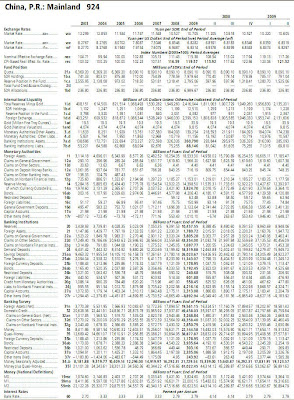


You can see an example about China in the following table.

Database 1: World Economic Outlook (WEO)
IMF: The World Economic Outlook (WEO) database is created during the biannual WEO exercise, which begins in January and June of each year and results in the April and September WEO publication. Selected series from the publication are available in a database format. These series are about national accounts,monetary,people, Government finance, Balance of Payments.
You will see an example with China and Germany in the table.
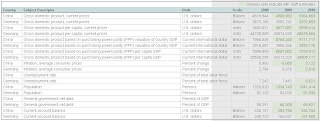
PS: based on the data, a survey by IMF staff - World Economic Outlook Reports - usually published twice a year. It presents IMF staff economists' analyses of global economic developments during the near and medium term.
You will see an example with China and Germany in the table.

PS: based on the data, a survey by IMF staff - World Economic Outlook Reports - usually published twice a year. It presents IMF staff economists' analyses of global economic developments during the near and medium term.
Abonnieren
Posts (Atom)